Physiological scenarios compatible with biofunctional
Physiological scenarios compatible with ABIMPROSYC biofunctional architecture
The ABIMPROSYC line has been designed to support complex physiological processes from a biostructural perspective, without pharmacodynamic interference or therapeutic aspiration. Each formula integrates families of compounds compatible with functional molecular pathways, organized to modulate key aspects of advanced immunonutrition , mitochondrial longevity, redox response, and adaptive recovery.
The applications are not defined by a medical diagnosis, but rather by the user’s functional profile, their physiologically demanding environment, and their goals for sustained metabolic resilience. The design of each variant follows a structured model that allows interventions across different physiological domains without invading clinical territory.

FUNCTIONAL IMMUNOCELLULAR SUPPORT
ABIMPROSYC T-DEFENSE
is intended for individuals who have experienced elevated immune load, follow-up after intensive treatments, compensated immunometabolic dysfunction, or periods of accelerated immunosenescence. It is also suitable for users with prolonged structural fatigue, slow functional recovery, or a family history of complex cellular processes.
biostructural axes:
- Activation of intracellular mechanisms such as Nrf2/SIRT1
- Regulation of the immune microenvironment (CD8⁺/MHC-I)
- Optimization of non-pharmacological adaptive surveillance
- Mitochondrial redox stabilization with sustained functional recovery

STRUCTURAL INFLAMMATORY SUPPORT
ABIMPROSYC REGENERA
Formulated for individuals with ongoing exposure to low-grade inflammatory processes, stabilized autoimmunity, slow tissue repair, or an imbalance in the mucosal-immune axis. Applicable in profiles requiring progressive structural restoration without immunosuppression and with a focus on digestive, joint, or epithelial integrity.
biostructural axes :
- Modulation of chronic proinflammatory pathways NF-κB, COX-2, NLRP3
- Support for endogenous antioxidant systems (GSH, catalase, SOD)
- Intestinal symbiotic synchronization with encapsulated strains
- Integration of structural peptides (collagen, zinc, magnesium)

BIOADAPTIVE LONGEVITY SUPPORT
ABIMPROSYC VITALIS
Designed for functional adults with progressive loss of basal energy, irregular sleep, decreased cognitive focus, or markers associated with accelerated aging. Its biphasic AM/PM architecture aligns the intake of bioactive compounds with the circadian mitochondrial rhythm, promoting the recovery of high-turnover systems.
biostructural axes :
- Increased intracellular availability of NAD⁺ (NR)
- Synchronized mitochondrial biogenesis with PQQ and CoQ10
- Regulation of the melatonin-GABA axis for nighttime repair
- Epigenetic preservation and functional cognitive plasticity

NEUROENERGETIC AND PERFORMANCE SUPPORT
ABIMPROSYC SPORT
Developed for users with high physical or neurocognitive load, post-exertion recovery, states of accumulated fatigue, or loss of functional performance without an obvious structural cause. The formula modulates the activation-recovery axis through
adaptogenic, mitochondrial, and neuromodulatory components , without resorting to stimulants.
biostructural axes :
- Mitochondrial stimulation and intracellular transport of fatty acids
- Post-exertion redox regulation (MSM, NAC,
astaxanthin)
- Neuroendocrine balance with GABA and ashwagandha
- Circadian synchronization of deep recovery


FORMATS AND PERIODICITY OF USE
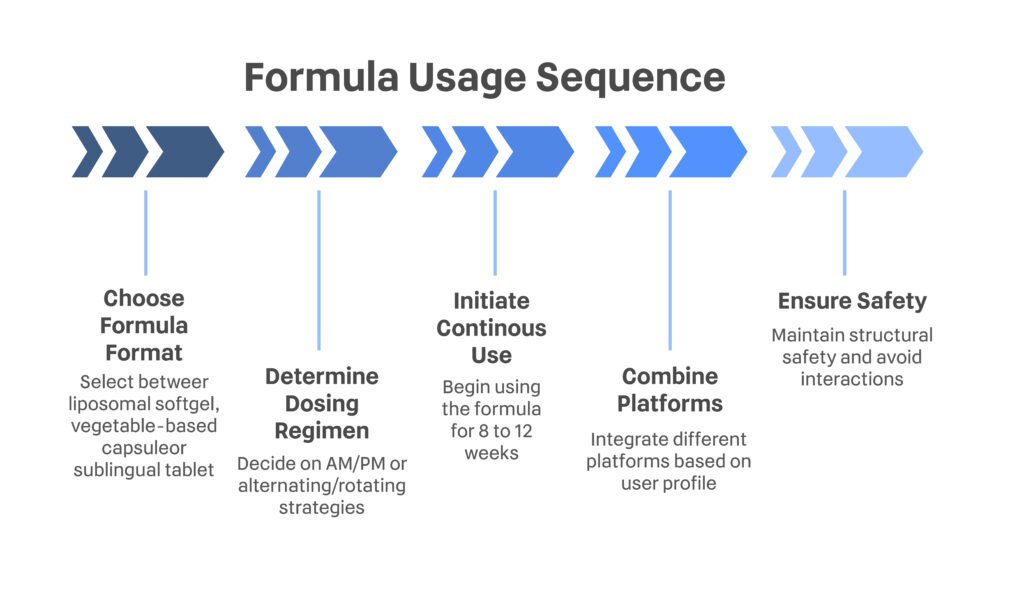
All formulas are available in biphasic AM/PM regimens, with three different capsules per dose:liposomal softgel, functional vegetable-based capsule
and sublingual tablet. The recommended minimum continuous use is 8 to 12 weeks, unless specific alternating or rotating dosing strategies are used.
The platforms can be combined, alternated, or sequenced according to the user’s functional profile, always maintaining the structural safety framework established by their GRAS composition and the absence of significant pharmacodynamic interactions.